
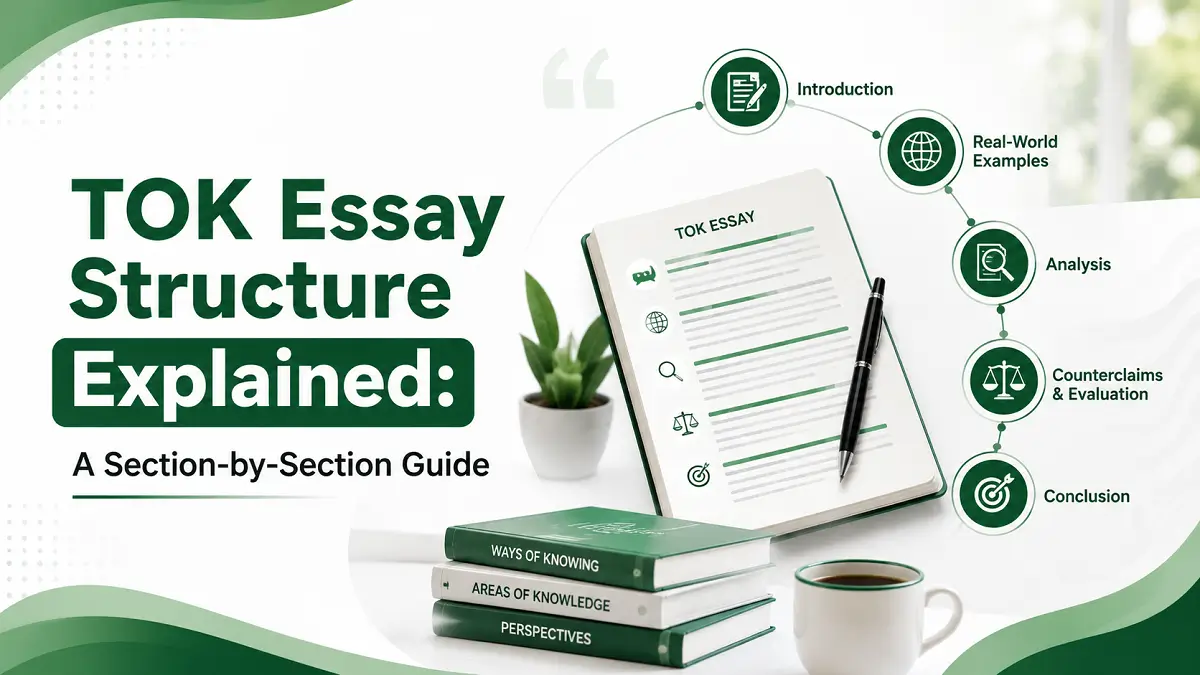
Writing a Theory of Knowledge (TOK) essay can feel difficult when you are unsure how to organize your ideas. A TOK essay is not simply about presenting information or proving that one argument is correct, as happens in a usual academic essay. It asks you to explore a knowledge question, consider different perspectives, and examine how knowledge is produced, justified, and interpreted.
A clear structure can make this process easier. An IB writing service suggests that while there is no single formula that guarantees a strong TOK essay, learning how to organize your discussion into purposeful sections can help you develop a focused argument without losing the exploratory nature of TOK.
Keep reading to learn the right way to structure your TOK essay.
What Should a ToK Essay Include?
A TOK essay generally consists of an introduction, a series of developed arguments and counterarguments, and a conclusion.
These essays are a bit tricky compared to other writing tasks, and this is why a lot of students choose to get help from an experienced ToK essay writing service.
A useful structure as per the 1600 word count limit for this essay includes:
- Introduction and interpretation of the title.
- First argument and supporting example.
- Examination of an alternative perspective or counterclaim.
- Second argument developed through another example.
- Further consideration of opposing perspectives.
- Conclusion that brings the discussion together.
But remember that these sections should not be treated as separate boxes to fill. Each part should contribute to the central knowledge discussion.
The exact organization can vary depending on the prescribed title and the argument you want to develop.
Below is the structure followed by most of the high-scoring papers.
Start With a Focused Introduction
The introduction will establish the direction of your essay, so start by showing that you understand what the prescribed title is asking.
You can briefly explain important terms in the title, identify the knowledge issue you intend to explore, and establish the position you will investigate.
A strong introduction should give the reader a sense of where the discussion is heading without explaining your entire argument immediately.
You might consider:
- What does the title actually ask?
- Which words require interpretation?
- What assumptions are contained within the question?
- Which areas of knowledge are relevant?
- What perspectives might produce different answers?
Avoid spending too much of the essay introducing background information. TOK rewards analysis of knowledge rather than a long general introduction to a subject.
Develop Your First Main Argument
Move on to your first major argument once your introduction has built your focus.
This section should make a clear claim that responds to the prescribed title. The claim should then be explored in detail instead of just being stated.
For example, if your title concerns whether evidence is always necessary for knowledge, you could examine a situation in one area of knowledge where evidence plays an important role.
A real-world example can make the discussion concrete, but the example should not become the main focus.
Ask what the example reveals about knowledge.
You could consider:
- How was knowledge established?
- What counted as evidence?
- Who decided whether the evidence was reliable?
- Could the same evidence be interpreted differently?
- What limitations affected the knowledge claim?
These questions help move the essay from description towards TOK analysis.
Examine a Counterclaim or Alternative Perspective
You need to remember that a strong TOK essay should not read like a one-sided argument.
After developing a claim, consider a reasonable alternative perspective. This does not mean adding a sentence that simply says “however”.
Experts from an IB writing service suggest that the alternative should genuinely challenge or complicate your original position.
For instance, evidence may appear essential in one context, but another perspective might suggest that interpretation or experience also influences how knowledge is developed.
The purpose is to explore why reasonable people might reach different conclusions.
This can make your analysis more nuanced and demonstrate that the knowledge issue cannot necessarily be reduced to a simple yes-or-no answer.
Develop a Second Argument
Your second main argument should add something new to the essay.
- Avoid simply repeating the first paragraph with a different example.
- Instead, consider whether another area of knowledge or situation produces a different response to the prescribed title.
This can help you move from a straightforward claim towards a more developed position.
For example, your first argument might suggest that personal experience influences knowledge, while your second could examine situations where personal experience creates bias or limits understanding.
This kind of contrast gives your essay room to explore complexity.
Challenge Your Second Argument
The second argument should be tested just as carefully as the first. Once you have introduced your claim and supporting example, consider what could weaken your interpretation.
The important part is what you do with this disagreement. Do not simply state that another perspective exists. Examine why it challenges your claim and whether the challenge changes your position.
You can ask:
- What makes the counterargument convincing?
- Does it expose a limitation in the original claim?
- Could both perspectives be valid under different circumstances?
- What does the disagreement reveal about the way knowledge is developed or justified?
This gives the second argument the same depth as the first and helps the essay maintain a balanced TOK discussion.
Keep Linking Back to the Knowledge Question
A common problem in TOK essays is losing sight of the actual knowledge issue.
A paragraph can contain an interesting example but still become irrelevant if the discussion moves too far away from the prescribed title.
After introducing an example or perspective, connect it back to the central question.
Ask yourself:
- What does this tell us about knowledge?
- Does it support or challenge my original claim?
- Has my understanding of the title changed?
- Does this example reveal a limitation?
- Under what circumstances might the argument apply?
These connections help maintain a clear line of reasoning throughout the essay. A lot of students also choose to get feedback from an IB writing service to ensure that their example and counterargument connect back to the prescribed title.
Write a Conclusion That Reflects Your Discussion
The conclusion should not simply repeat your introduction.
By this point, your discussion should have considered different claims and perspectives. Your conclusion should therefore reflect what you have discovered through that exploration.
For example, instead of saying that one approach is always correct, you might conclude that its usefulness depends on the context or standards used to evaluate knowledge.
A good conclusion should leave the reader with a clear understanding of your overall position and the conditions that influence it.
FAQS
- How many paragraphs should a TOK essay contain?
There are no requirements in terms of a particular number of paragraphs. This depends on the argument, your examples, and the prescribed title. Try to work out your ideas instead of following a paragraph count.
- Does my TOK essay need a thesis statement?
Your essay needs to have a particular direction, but TOK arguments can be more qualified than the thesis in an argumentative essay. Your opinion may take shape while considering the knowledge question from different angles.
- Can I use personal examples in my TOK essay?
Personal experience can be helpful sometimes if it really sheds light on the knowledge issue. Nevertheless, make sure that it leads to discussion rather than becoming a personal story which is not related to the prescribed title.
Key Takeaways
A well-defined structure for a TOK essay provides you with a way to develop ideas without turning your essay into a mere formula. So follow the structure recommended by an IB writing service, which is to begin by analyzing the prescribed title, then build arguments based on the help of examples and evaluate perspectives that might oppose the views expressed. Ensure that you continually return to the main knowledge issue throughout the discussion and use examples in support of your arguments instead of making them the main focus. And yes, don’t forget to conclude your analysis of different perspectives.