Walk into almost any growing company today and you’ll find the same problem hiding behind the scenes: dozens of tools that don’t talk to each other. Sales runs on one platform, finance on another, inventory somewhere else entirely, and customer support in its own little bubble. Everyone’s busy, nothing’s connected, and small cracks in communication turn into big losses down the line. System Integration in Qatar has become one of the fastest-growing priorities for businesses trying to fix exactly this kind of chaos before it costs them customers, time, or money.
That’s really what this article is about — not the technical jargon, but the practical shift happening inside organizations that decide to stop patching problems and start connecting systems properly.
What System Integration Actually Means (Without the Buzzwords)
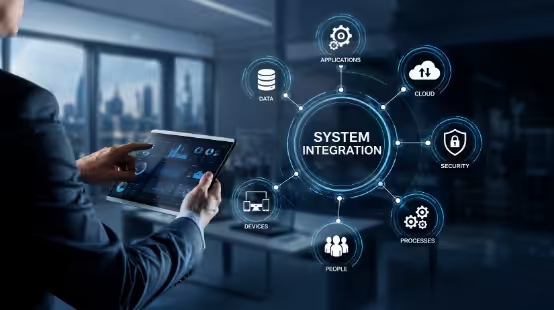
Strip away the consulting language, and system integration is simply the process of getting your different software tools, databases, and platforms to work as one connected system instead of a pile of disconnected apps. Your CRM should know what your accounting software knows. Your warehouse management tool should update your e-commerce store the second stock changes. Your HR platform shouldn’t require someone to manually re-enter the same employee data three times across three systems.
When that connection exists, information moves on its own. When it doesn’t, people become the connection copying, pasting, double-checking, and inevitably making mistakes along the way.
Why This Matters More Now Than Five Years Ago
A decade ago, a business could survive with a patchwork of spreadsheets and standalone software. Competition was slower. Customers were more patient. Data didn’t multiply the way it does now.
None of that is true anymore. Customers expect instant responses. Supply chains shift overnight. Regulatory requirements change faster than most internal processes can keep up with. A business running on disconnected systems isn’t just inefficient it’s reacting to problems days or weeks after they’ve already happened, because nobody had visibility into the full picture in real time.
Future-ready businesses aren’t the ones with the flashiest technology. They’re the ones whose technology actually works together, giving leadership a real-time, accurate view of what’s happening across every department.
The Real Cost of Disconnected Systems
Most companies don’t realize how much disconnected systems are costing them until they map it out. A few common patterns show up again and again:
Duplicate work. Staff re-enter the same data into multiple platforms because those platforms can’t share it automatically. That’s paid hours spent on tasks a properly integrated system would handle instantly.
Delayed decisions. When reports have to be manually pulled from five different tools and stitched together in a spreadsheet, decisions get made on last week’s data instead of today’s.
Customer friction. A support agent who can’t see a customer’s full order history because it’s locked in a separate sales platform ends up giving a worse experience, even if they’re trying their hardest.
Compounding errors. One typo during manual data entry doesn’t stay contained it spreads across every system that data touches, and tracking down the source later eats up hours nobody has.
None of these are dramatic failures on their own. They’re small leaks. But small leaks, left alone, sink the ship eventually.
How Integration Actually Builds a Future-Ready Business
1. It Creates a Single Source of Truth
When systems are integrated, everyone in the organization is looking at the same numbers. Sales isn’t working off different figures than finance. Operations isn’t guessing at inventory levels while warehouse staff know the real count. This alignment alone eliminates a huge amount of internal friction and finger-pointing.
2. It Makes Scaling Actually Possible
A business trying to grow on disconnected systems hits a wall fast. Every new client, every new product line, every new market adds more manual work rather than less. Integrated systems, by contrast, scale by design a new order, a new employee, a new transaction flows through the existing connected architecture without needing a human to shepherd it through five different tools.
3. It Frees Up People for Actual Thinking Work
Every hour an employee spends manually reconciling data between two systems is an hour they’re not spending on strategy, customer relationships, or problem-solving. Integration doesn’t just save time it redirects human effort toward the work that actually needs a human.
4. It Improves Decision-Making Speed
Leaders can’t make good calls on outdated or incomplete information. Integrated systems feed real-time dashboards and reports pulled from every corner of the business, which means decisions get made faster and with far more confidence.
5. It Strengthens Security and Compliance
Ironically, having fewer disconnected data silos often makes a business more secure, not less. When data flows through controlled, integrated pathways instead of being manually exported, emailed, and re-uploaded across a dozen tools, there are fewer opportunities for sensitive information to leak or get mishandled.
What Good System Integration Looks Like in Practice
Effective integration isn’t about buying the most expensive software on the market. It usually comes down to a few practical steps:
- Mapping the existing tech stack to understand exactly which tools are in use and where the disconnects are happening.
- Prioritizing high-impact connections first usually finance, sales, and operations, since these tend to bleed the most time and money when disconnected.
- Choosing the right integration approach, whether that’s APIs, middleware platforms, or a unified ERP system, depending on the complexity of the business.
- Testing thoroughly before full rollout, since a poorly integrated system can create new problems instead of solving old ones.
- Training staff on the new workflows, because even the best integration fails if people revert to old manual habits out of comfort.
Businesses that get this right don’t treat integration as a one-time IT project. They treat it as ongoing infrastructure something that gets revisited and refined as the company grows and new tools enter the picture.
Choosing the Right Partner for the Job
This is where a lot of businesses either win big or waste a significant budget. Integration work touches sensitive data, critical workflows, and systems the entire business depends on daily — it’s not something to hand off casually. Working with experienced Top IT System Integrators companies in Qatar gives businesses access to teams who’ve already solved these exact problems across different industries, which usually means fewer costly mistakes and a faster path to a system that actually works the way it’s supposed to.
The right partner won’t just plug tools together. They’ll ask hard questions about how the business actually operates, where the bottlenecks really are, and what growth looks like over the next few years then build an integration strategy around that reality instead of a generic template.
Looking Ahead
The businesses that will still be standing strong in five or ten years aren’t necessarily the ones with the biggest budgets today. They’re the ones building systems that can adapt, scale, and respond quickly when the market shifts because that’s what “future-ready” actually means in practice, not just in a slide deck.
System integration isn’t a luxury reserved for large enterprises anymore. It’s become one of the most practical investments a business of any size can make, because every department it touches gets faster, cleaner, and more capable of handling whatever comes next.
The companies that treat their systems as one connected whole, rather than a collection of separate tools, are the ones setting themselves up to compete and win in a market that isn’t slowing down anytime soon.