Buying color for PET looks simple. It is not. The wrong additive can cloud a clear bottle, weaken a fibre, or leave streaks in a sheet. That is why the choice of a master batch manufacturing company in india matters so much when your product is PET. The right partner gives you color and function without hurting the polymer. The wrong one gives you scrap.
This guide keeps things plain. It covers what a masterbatch maker does, why PET needs special care, and how to pick a supplier you can trust.
What a masterbatch company actually does
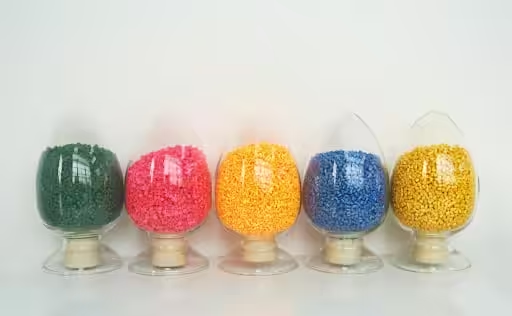
A masterbatch is color or additive packed into a carrier resin. You add a small amount to your natural polymer during molding or extrusion. It saves you from handling raw pigment on the shop floor. It also gives you steady, repeatable results.
A good maker does three jobs well. First, they disperse pigment evenly so you get no specks. Second, they match your target shade batch after batch. Third, they choose a carrier that suits your process. That third point is where PET gets interesting.
Why PET needs its own carrier
Most standard color is made on a polyethylene carrier. PE mixes into many plastics without trouble. But PET is fussy. A PE carrier can sit as a separate phase inside PET. In a clear bottle, that shows up as haze or tiny spots.
For PET, you want a PET-based carrier. It melts and blends with the base resin, so clarity stays high and strength holds. This is why buyers look for a proper PET masterbatch rather than a generic grade pulled off a shelf. The carrier match is not a detail. It decides whether the part looks right.
Drying and IV: the part people forget
PET picks up moisture from the air. If you run wet PET, the melt breaks down. Chains get shorter. The IV, or intrinsic viscosity, drops. You end up with brittle parts and poor bottle blowing.
The masterbatch matters here too. It should be dried and packed to stay dry. It should also be low in moisture on delivery. Ask your supplier how they dry and store it. A serious maker will have a clear answer.
Food contact and clarity for bottles
Most PET goes into packaging for water, oil, and food. So the color and additives must meet food-contact rules. Pigments should be approved for that use. The supplier should be able to share documents that prove it.
Clarity is the other big one. For clear or light tints, the pigment must be clean and well dispersed. Even a small amount of dust or poor mixing shows in a see-through bottle.
PET applications at a glance
| Application | Main concern | What the masterbatch must protect |
| Bottles | Clarity, food safety | Haze-free look, approved pigments |
| Fibre | Strength, fine dispersion | No breaks at the spinneret |
| Sheet | Even color, flatness | No streaks or gels |
How to choose a supplier
Price is easy to compare. Reliability is not. Look past the quote and check a few things.
• Do they make PET-carrier grades in-house, or just resell?
• Can they match a shade from your sample?
• Do they share food-contact and safety papers?
• How steady is their batch-to-batch color?
• What lead time can they hold, and can they scale with you?
Indian makers cover a wide range of PET needs. Suryamb, for example, is one maker that offers PET-carrier grades for bottle, fibre, and sheet work. Use names like this as a starting point, then test for yourself.
Running a proper trial
Never switch on volume alone. Run a trial first. Send your own PET and process settings. Ask for the same grade you would buy later, not a special sample.
Check the color under real light. Check clarity in a finished part, not just a plaque. Blow a few bottles or spin some fibre and look for defects. Measure IV before and after if you can. Keep a retained sample so you can compare future lots.
A short trial saves long headaches. It also tells you how the supplier communicates when you ask hard questions.
Conclusion
PET rewards care and punishes shortcuts. The color you add is part of the polymer, so it has to behave like PET, not fight it. That is the real value of a good master batch manufacturing company in india: a carrier that blends, pigments that are safe and clean, and lots that stay the same. Match the carrier, mind the drying, check the papers, and always run a trial. Do that, and your bottles, fibre, and sheet will come out the way you planned.
FAQs
What is a masterbatch?
It is a color or additive concentrated in a carrier resin. You mix a small dose into your base polymer to color or modify it.
Why can’t I use a normal color masterbatch in PET?
Most standard grades use a PE carrier. In clear PET, it can cause haze or spots. A PET carrier blends in and maintains clarity.
Does the masterbatch affect PET strength?
It can. Moisture and a poor carrier lower IV and make parts brittle. A dry, PET-based grade helps protect strength.
Is masterbatch safe for water and food bottles?
It can be, if the pigments are approved for food contact. Ask the supplier for the supporting documents.
How much masterbatch do I add?
It depends on shade and grade, but doses are usually small, often one to a few percent. Your supplier will give a let-down ratio.
How do I compare Indian suppliers?
Look at in-house PET grades, color consistency, safety papers, lead time, and trial support.
What should a trial include?
Your own resin and settings, a finished part check, clarity and color review, and an IV check where possible.