
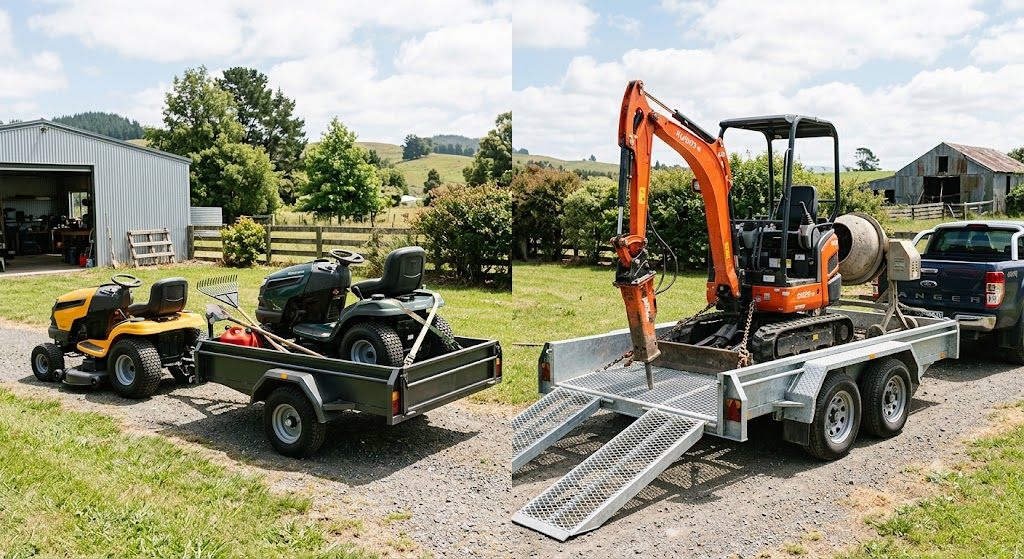
Choosing between a ride on mower trailer and a plant trailer depends on what you transport, how often you travel and the weight of your equipment. A mower trailer is generally suited to lawn care equipment and lighter machinery, while a plant trailer is designed for heavier equipment used in construction, landscaping and agriculture. Comparing their capacity, loading features, towing requirements and price can help you choose a trailer that suits your daily work.
What Is a Ride-On Mower Trailer?
A ride on mower trailer is designed to transport ride-on lawn mowers safely between properties or job sites. It usually has a low deck, loading ramp and tie-down points to make loading and securing the mower easier. Some models also provide space for fuel containers, gardening tools and smaller lawn care equipment.
These trailers are commonly used by gardening contractors, property maintenance businesses and homeowners managing large blocks. Their relatively compact dimensions can make them easier to store and manoeuvre than heavier alternatives. However, load capacity varies considerably, so the combined weight of the mower, attachments, fuel and tools must remain within the trailer’s rated limit.
What Is a Plant Trailer?
A plant trailer is built to carry heavier machinery, including mini excavators, skid-steer loaders, compact tractors and similar equipment. Its construction may include a reinforced chassis, heavy-duty suspension, multiple axles and stronger loading ramps. These features allow the trailer to handle concentrated machinery weight and demanding work environments.
Plant trailers often provide a higher aggregate trailer mass than mower-specific models. They may also include features such as adjustable ramps, stabiliser legs, electric brakes and numerous load-restraint points. Their strength provides greater flexibility, but it also increases the trailer’s purchase price, tare weight and towing requirements.
How Do Their Load Capacities Compare?
Load capacity is one of the most important differences. A mower trailer is generally designed for lighter equipment, while a plant trailer accommodates substantially heavier machinery. Buyers should check the trailer’s payload, not simply its overall size, because the trailer’s own weight forms part of its aggregate trailer mass.
Calculate the total weight of everything you expect to carry, including attachments and additional tools. Allowing some spare payload capacity is sensible, especially if your equipment needs may change. Overloading a trailer can affect handling, braking and tyre performance, while also creating safety and compliance concerns on Australian roads.
Which Trailer Is Easier to Load?
Both trailer types may include ramps, but the ramp design should suit the equipment being transported. Ride-on mowers generally require wide, slip-resistant ramps with an approach angle that prevents the mower deck from scraping. A low trailer floor can make the loading process smoother and reduce the risk of damage.
Heavier machinery requires ramps rated for its full operating weight. Plant trailers may use reinforced ramps, stabilising supports and beavertail designs to improve loading stability. Buyers should also check whether the ramp spacing matches the machine’s wheel or track width and whether the tie-down points are positioned for effective load restraint.
What Are the Towing Requirements?
Before purchasing either option, confirm that your vehicle is legally and mechanically suitable for towing it when fully loaded. Consider the vehicle’s towing capacity, tow-ball download limit and gross combination mass. A trailer that appears manageable when empty may exceed the vehicle’s limits once machinery, attachments and tools are added.
Braking and registration requirements can depend on the trailer’s weight and the rules that apply in your state or territory. The tow vehicle may also need a compatible brake controller. Checking these details before buying helps avoid the cost of modifying your vehicle or replacing an unsuitable trailer later.
Which Option Is More Cost-Effective?
A mower trailer is often the more economical choice when lawn equipment is the primary load. It generally costs less to purchase, may be lighter to tow and can require less storage space. Buying a heavy-duty alternative for a single lightweight mower may add expense without providing meaningful day-to-day benefits.
A plant trailer may offer better long-term value when your work involves different types of machinery. Its higher capacity and stronger structure can reduce the need to purchase another trailer as the business expands. However, the larger investment is worthwhile only when the added strength and flexibility will be used regularly.
Conclusion
Choose a mower trailer if you mainly transport ride-on lawn equipment and want a compact, practical towing solution. Select from plant trailers australia suppliers when you need to move heavier machinery or require greater flexibility for future equipment. Whichever type you choose, confirm its payload, dimensions, braking system and compatibility with your tow vehicle. The right trailer should carry your equipment safely without adding unnecessary weight, complexity or cost.