Frankly, I remember a huge portion of my career was going around industrial plants in Gujarat and Maharashtra. And there is actually one particular sound out of those industrial visits that still causes me anxiety. It’s the sudden and very shrill cavitation whine of a centrifugal pump that’s the sound of a multi-lakh piece of machine not only breaking down but essentially trying to destroy a loose bolt or a piece of scale that broke off an old pipe.
One instance that stays with me is when we were commissioning a chemical processing line near Chennai. Our team was very stressed as the client was pressing to see the production by the end of the week. To save some time and, let’s be honest, some thousands of rupees, the procurement head had bought some “generic” strainers. They looked good on the surface. But three days later, a weld on the internal mesh gave way.
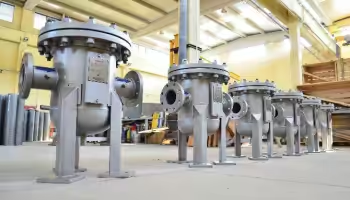
In the fast-changing Indian industry, when we are increasing production of everything from green hydrogen to huge food processing centers, selecting a Basket Strainer India doesn’t just mean going for the cheapest offer. It’s about securing your investment.
What Makes the “Basket” Design an Industrial Star?
You may be asking, “Why go for a basket strainer? Why not a simple Y-strainer?” I think this mostly goes back to the large amount of “stuff” present in industrial liquids in India. Be it borewell raw water or chemicals, you need the capacity to hold particles.
Volume, the Major Benefit
A Y-strainer on the other hand is suitable for steam or gases where hardly any debris or particles. However, when it comes liquid applications, the basket design offers you a much bigger surface area. As a result, you can collect a lot more “gunk” before the pressure drop (the $DP$ or $\Delta P$ for the engineers in the room) becomes an issue.
What’s Good about Maintenance?
Just tell us the truth: if a piece of equipment is difficult to clean, your maintenance team will probably not get to it. Personally, I think the best point of a basket strainer is the top-opening design. This way if you want to clean, you just have to undo the bolts of the lid, take out the covery handle, and empty the debris.
No line draining necessary, no inconvenient angles to wrestle with!
Figuring What You Want: The ‘Non-Negotiables’
It’s always better to first crystal-clear your specs before you even begin hunting for a Basket Strainer India supplier. Many folks fall into the trap of a step skip by thinking “a strainer is a strainer” but this is precisely where things go wrong.
1. Material Compatibility (Not Only Steel)
These days in India, one can find pretty much everything from Cast Iron to Duplex Stainless Steel.
- Cast Iron: Okay for non-critical water lines. Cheap, but very brittle.
- Carbon Steel (WCB): Good old faithful.
For instance, if you operate a coastal plant in Vizag and you are handling seawater, if you use unsuitably standard Carbon Steel without a lining, then within a six-month period the strainer will become nothing but a sieve.
- Mesh and micron ratings
Here’s where confusion usually kicks in. The basket holds things together, while inside it sits the mesh doing the filtering work.
Holes punched through the sheet catch bigger trash or stray bits of metal. This kind works when chunks are too large for finer filters. Built to handle heavy junk without clogging fast. Metal scraps, broken parts, odd fragments – these get stopped early. The open pattern lets flow continue while trapping what matters
Ah, here’s the thing – when your pump manages 200-micron bits, aiming for 40 isn’t smarter. Finer filters slow down quicker since gunk builds up sooner. That means scrubbing them way too often while power bills climb. Balance wins, every time.
Picking the Best Manufacturer in the Indian Market
It’s a jungle out there in the Indian market, isn’t it? You can come across world-class manufacturers in Coimbatore and Ahmedabad, but you also have some “backyard” fabricators who can very well fake your strainer product by taking all imaginable shortcuts.
Step 1: Check for Certifications (The Paper Trail)
Don’t think for a minute that certifications are just another red tape in India–they are actually your only real safety guarantee.
- ISO 9001:2015: That is the minimum. No point looking further if they can’t show this one.
- ASME Section VIII: If you have high-pressure lines, technically, your strainer is a “pressure vessel.” It should be made and tested according to these codes.
- Third-Party Inspection (TPI): Awarding who carry out inspections, like Lloyd’s, Bureau Veritas, or TUV. When you talking about TPI and they show reluctance, then that’s a huge red flag.
Step 2: The “Reality Check” on Manufacturing
If at all possible, take a trip to their factory.
- look at their welding setup, if they use automated welding.
- They should also have an in-house Hydro-testing rig.
Industrial Applications Driving Demand in India
India’s industrial growth is not limited to any single sector; it’s spreading in multiple directions. Each of them has their specific requirements concerning filtration.
1. Water and Wastewater Treatment Becoming a Priority
The government’s Jal Jeevan Mission along with ZLD (Zero Liquid Discharge) norms have combined to triple basket strainer demand. In fact, these are not the 2-inch pipes but rather 24-inch monster sized ones that are protecting the desalination membranes.
2. The Growth Story of Specialty Chemicals
India is fast becoming the “plus one” to China in the global chemical supply chain. These chemical plants are dealing with aggressive fluids and high temperatures. Demand for “Simplex” or “Duplex” basket strainers rose in the sector.
Hint: A Duplex Basket Strainer is the best option when your process cannot be interrupted even for ten minutes to clean a filter. It has two separate chambers and a change-over valve. When one side gets full, simply flip the lever and clean it while the other side runs the factory.
3. Food and Beverage (The Hygiene Factor)
Consider the large dairy cooperatives or bottling plants in North India. They use “Sanitary” strainers. It means the internals are polished, no “dead spots” where bacteria can grow, and easy-clean tri-clover fittings.
The Price vs. Value Conundrum: How to Deal with “Cheap” Offers
I guess you have been there. You request three quotes. Two are really close, while the last one is 30% cheaper. You are attracted to the cheap offer, which is natural. However, in the industrial hardware world, that 30% discount mostly comes from compromising the product’s quality.
The Corner-Cutting Dangers:
- A thin wall could mean trouble down the line. Some strainers save costs with lighter builds – fine at first, under test conditions. Yet once hit by constant shifts in pressure? Corrosion begins its work. Two years later, failure shows up quietly. Cracks appear where strength used to be.
- A closer look at the basket material reveals something off. You ordered SS316, yet what arrives could easily be SS304 instead. On sight alone, telling them apart is impossible. However, once placed near salt or acid, differences show fast. Where 316 holds up, 304 begins to corrode and weaken.
- A strainer works just fine – until the seal fails. Most budget versions rely on weak rubber, which turns brittle fast when heated. After a couple of uses, tiny gaps appear, then drips follow.
In fact, you should view the procurement of Basket Strainer India as an insurance plan. Of course, you don’t wish the mesh to come into contact with a very dangerous piece of debris; nevertheless, you want to be certain that it won’t actually get damaged in such a situation.
Installation and Maintenance: Don’t Kill Your Strainer
Great job on picking out a top-class strainer. But I have witnessed several cases where even impeccable pieces of equipment were ruined by improper installation.
- Hard installs don’t mean better results – backward fits happen, especially with bins and dampeners. Look for the arrow marked on the surface. Flip it wrong, particles stick outside the holder. Until opened, those bits drift back into the clean flow unchecked.
- Heavy loads test weak spots. A big strainer filled with gunk adds serious strain on drain pipes. Flanges weren’t made to hold that much pressure over time. Let gravity work smarter, not harder. Build in extra under-sink bracing before problems start.
- A pair of pressure gauges tells the real story. Put one upstream, another downstream of the filter. As gunk builds up, the gap between readings grows. That shift marks when cleaning makes sense. Numbers beat hunches every time. Watch them closely. Decisions get easier with actual values in hand
Looking Ahead: The Future of Filtration in India
The transition to “Industry 4.0” means that even simple things like strainers are getting a technology boost. I’m seeing manufacturers in the Basket Strainer India space coming up with “Smart Strainers.” These are equipped with sensors that notify your phone when the basket is about 80% full.
Would it be too much? Maybe for a simple cooling water line. However, for a mission-critical refinery? It’s a game-changer. It transitions maintenance from “reactive” (fix what is broken) to “predictive” (clean it just before it causes a problem).
The Environmental Concern
Besides that, we cannot forget about the waste. Choosing a high-quality basket strainer is a sustainable product because it is permanent. Unlike cartridge filters that you throw away every month, a basket is cleaned and reused for decades. In today’s world where everyone is really focused on ESG (Environmental, Social, and Governance) goals, opting for “cleanable” instead of “disposable” is simply good business.
Conclusion
While you are searching for a Basket Strainer India supplier, pick one who will ask questions. Don’t be lulled into a false sense of security by someone who just takes your order and sends an invoice. A quality partner will inquire about your flow rates, viscosities, and cleaning schedules. They will desire to make sure the equipment will truly solve your problem.
Never let a slight price difference be the reason for you to compromise your entire fluid system. That little money-saving that you do up front will almost certainly result in you paying back that amount ten times over in the form of higher energy bills, maintenance woes, and, if we consider the worst case, safety hazards.
Yes, it may sound a tad dramatic. However, when the scene is a plant that is silent and a five-rupee bolt made a five-lakh pump defective, you will understand that “dramatic” is just another word for “prepared.”