Growing a business changes what you need from your manufacturing side, whether you’re ready for that or not. Orders get bigger. Deadlines get shorter. Specs that used to stay put for months now change every few weeks, and customers who once cut you slack now expect things to just work. Somewhere in that mess, the supplier you picked back when you were small starts to matter a lot more than you’d think.
Honestly, a lot of manufacturers can handle a small business fine but fall apart once volume picks up. They don’t have the systems for it, or the staff, or honestly the patience. And price isn’t really the thing to chase here, even though it’s tempting. What you actually want is a supplier who picks up the phone, tells you the truth when something’s going to be late, can scale with you instead of choking on a bigger order, and doesn’t panic every time you need to tweak a spec. That’s the difference between a supplier who grows with you and one who quietly becomes your biggest headache.
1. Consistent Product Quality
Product quality is one of the first things businesses should evaluate when selecting a manufacturing supplier. Inconsistent products can lead to customer complaints, returns, production problems, and additional inspection costs.
A dependable manufacturer should have established quality-control procedures throughout the production process. These may include:
- Raw material inspections
- Production-stage quality checks
- Dimensional and specification testing
- Final product inspections
- Packaging inspections
- Defect identification and correction
Businesses should also ask how the supplier handles products that fail to meet agreed specifications. A manufacturer with a clear quality-control process is more likely to maintain consistency as order volumes increase.
2. Production Capacity and Scalability
A supplier should be able to grow with the business rather than becoming a limitation when demand increases. This is particularly important for companies expecting higher order volumes after launching new products or entering new markets.
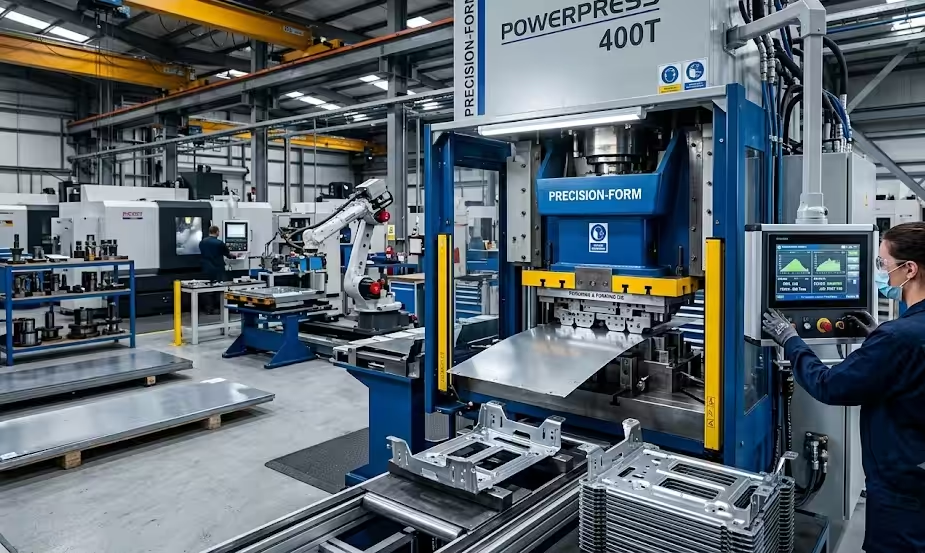
For example, businesses sourcing customized metal components may work with an Aluminum Profile Manufacturer China that has suitable machinery, production capacity, and technical resources to handle both initial orders and future increases in demand.
Scalability depends on more than factory size. Businesses should consider whether the supplier has:
- Adequate production equipment
- Skilled technical workers
- Sufficient material availability
- Flexible production schedules
- Reliable quality-control systems
- Capacity for larger future orders
A supplier that can increase production without compromising quality or delivery schedules can become a valuable long-term manufacturing partner.
3. Dependable Delivery Performance
For growing companies, manufacturing delays can quickly become business problems. A late shipment may affect inventory levels, product launches, customer orders, and relationships with retailers or distributors.
Reliable suppliers provide realistic lead times and make reasonable commitments rather than promising unrealistic delivery dates.
Before selecting a manufacturer, businesses should find out:
- How long standard production normally takes.
- How custom orders affect lead times.
- How production schedules are managed.
- What happens when unexpected delays occur.
- How quickly customers are informed about schedule changes.
A supplier that communicates early about potential delays gives businesses more time to adjust their own plans.
4. Clear and Responsive Communication
Manufacturing often involves detailed discussions about dimensions, materials, quantities, finishes, packaging, tolerances, and shipping requirements. Poor communication can result in expensive mistakes.
A reliable supplier should provide clear answers and confirm important specifications before production begins.
Good communication usually includes:
- Quick responses to important questions
- Clear production updates
- Confirmation of technical specifications
- Transparent explanations of potential problems
- Regular communication about order status
A responsive supplier makes it easier for growing businesses to manage production without constantly chasing updates.
5. Transparent and Competitive Pricing
Price matters, but the cheapest supplier is not always the most cost-effective option. A low quotation can become expensive if it is followed by unexpected charges, inconsistent quality, or frequent production delays.
Businesses should look for manufacturers that clearly explain their pricing structure. Important factors to review include:
- Unit production costs
- Tooling or setup charges
- Material costs
- Packaging expenses
- Shipping costs
- Minimum order quantities
- Potential volume discounts
Transparent pricing allows businesses to calculate margins more accurately and plan future orders with greater confidence.
6. Strong Technical Capabilities
As a company expands, its manufacturing requirements may become more complex. A supplier that only handles basic production may eventually struggle with customized designs, tighter tolerances, new materials, or specialized finishing.
A capable manufacturing partner should have appropriate machinery and technical expertise for the products being produced. For businesses that require precise custom components, CNC Machining China can be an important manufacturing option, particularly when accuracy, repeatability, and complex designs are involved. Engineering support can also help businesses improve product designs and identify ways to make manufacturing more efficient.
When evaluating a supplier, businesses should examine:
- Available machinery
- Production technologies
- Material expertise
- Custom manufacturing capabilities
- Engineering support
- Finishing and treatment options
These capabilities can become especially valuable when a product moves from a small production run to larger-scale manufacturing.
7. Organized Quality and Production Systems
Reliable manufacturing companies generally depend on structured systems rather than informal processes. Organized production systems help maintain consistency even when order volumes increase.
A supplier should ideally have processes for:
- Production planning
- Inventory management
- Equipment maintenance
- Quality inspections
- Defect tracking
- Order documentation
- Final shipment checks
Certifications can also be useful depending on the industry, but businesses should look beyond certificates. The supplier’s actual production processes and track record are equally important.
8. Flexibility When Requirements Change
Growing businesses rarely remain completely predictable. Product designs may change, order quantities may increase, or delivery requirements may shift because of market demand.
A reliable supplier should have some flexibility to accommodate reasonable changes without creating unnecessary complications.
For example, a business may suddenly need:
- A higher production quantity
- A modified product specification
- Different packaging
- A faster production schedule
- Additional quality inspections
Suppliers that can adapt to changing requirements can make growth much easier to manage.
9. Reputation and Previous Experience
A supplier’s track record can reveal a great deal about its reliability. Businesses should research potential manufacturers before committing to large production orders.
Useful evaluation methods include:
- Reviewing customer feedback
- Requesting product samples
- Checking previous projects
- Asking for relevant references
- Reviewing manufacturing capabilities
- Evaluating communication during the quotation stage
Sample orders are particularly useful because they allow a company to evaluate quality, packaging, finishing, and consistency before moving to larger production volumes.
10. Focus on Long-Term Partnerships
The strongest supplier relationships are built around long-term cooperation rather than individual orders. As businesses grow, suppliers that understand their products and expectations can become increasingly valuable.
A long-term manufacturing partner can help with:
- Improving production efficiency
- Maintaining consistent specifications
- Planning larger orders
- Reducing recurring manufacturing issues
- Identifying cost-saving opportunities
- Supporting new product development
Businesses should therefore consider whether a supplier is interested in building an ongoing relationship instead of simply completing one transaction.
Conclusion
Get the supplier relationship right, and it can genuinely make or break how smoothly a growing business scales. It’s not just one thing either. Quality has to hold up batch after batch, capacity needs room to grow, deliveries need to actually show up on time, and someone needs to answer the phone when things go sideways. Pricing that’s upfront rather than full of surprises helps too, and so does a supplier who actually knows the technical side of what they’re building for you.
Cost is usually the first thing businesses look at, and honestly it shouldn’t be. What matters more is whether the supplier has the systems and experience to handle more volume than they’re handling today, and whether they’re even willing to grow alongside you instead of just serving you as-is.
At the end of the day, the manufacturers worth sticking with are the ones who deliver what they promised, when they promised it, at a quality level you don’t have to keep double-checking. Do that consistently, and they stop being just another vendor on a spreadsheet. They turn into something closer to a partner, one that’s actually built into how the company plans to grow.