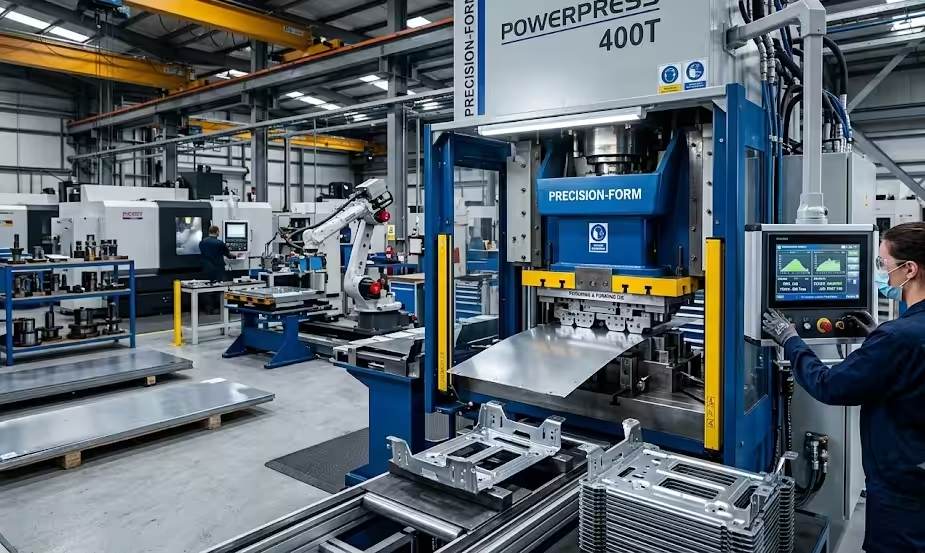
A mid-sized automotive component manufacturer in Pune recently won a contract to supply precision-stamped bracket assemblies for a major EV plant. The production line looked set, the toolings were engineered to strict tolerances, and the project was very ambitious. In order to keep capital expenditure low, the procurement team purchased a heavy-duty mechanical press mainly on the basis of a competitive price quote and a promise for fast delivery. Already six weeks later, minute deflections of the press bed were causing uneven die wear, regular tool chipping, and dimensional drift of critical hole centers. What started as a cost-saving measure was quickly overtaken by unplanned downtime, rework of component lots, and tooling re-grinds.
This kind of situation is typical and frustrating enough that it seems like stories such as ours should not happen so frequently. Procuring metal-forming equipment is not merely about pairing tonnage to a sketch. In the case of mechanical presses, the machine is subjected to a shock-loaded repetitive work cycle, which eventually reveals any hidden compromise in the frame rigidity, clutch reaction, or the forging of the crankshaft.
Therefore, for buyers and managers alike, choosing a Power Press Machine Manufacturer involves achieving a compromise between technical aspects, reliability over time, and the total cost of ownership.
Metallurgy, the art of changing the form of materials, has advanced greatly. The power press, for instance, is a very complex machine with mechanical and electrical components that are controlled using computer software, etc., and a whole lot more. This evolution was due to several factors such as a reduction or elimination of human operators, a desire for higher machine tool utilization with fewer changeouts, and a need for greater quality and consistency in product manufacturing. For the person who is in charge of purchasing or who makes the decision, he or she must understand the benefits of these improvements in order to allocate investment wisely and be able to carry out the most suitable procurement plan.
What Is a Modern Power Press Machine?
The most basic description of a power press is that it is a metalworking machine tool used primarily for stamping processes. These machines consist of mechanical systems driven by an electric motor, which is connected to a flywheel that transfers the mechanical energy through a crankshaft, eccentric shaft, or toggle mechanism to move a guided slide (ram) vertically against a stationary bolster plate.
The basic principles of metal shearing and plastic deformation remain the same, but modern metal forming machines have seen a lot of changes in terms of structure design and control. One of the trends is that a pneumatic friction clutch replaces the traditional key clutch press mechanism. In the same vein, the hydraulic press system and servo-driven press are also becoming widely available. Contemporary metal forming press equipment is not complete without features such as monitoring of applied pressure, automatic lubrication, a linear moving system, and a rapid die-change setup. Regardless of the application, such as blanking high-strength steel automotive parts or drawing deep stainless steel enclosures, the modern press is designed for high-speed operation over a long period, operator safety, and consistent precision.
Press selection matters in industrial procurement.
Capital equipment procurement decisions have an impact on line capability, scrap levels, and operation overhead for a long time. The choice of machine will be reflected at many levels in the factory, for example:
- Quality of the Part and its Dimensional Accuracy: The frame’s deflection during full-load impact leads to a misalignment of the die. A strong, rigid low-deflection frame keeps very tight tolerances, eliminates tool marks or burrs after shearing, and prolongs the tooling’s life.
- Production Line Throughput: Stroke rates, press speed variability, and capability for automation (like servo feeders and progressive die setups) are the factors that govern directly hourly output and unit production costs.
- Unscheduled Downtime and Maintenance Costs: Economical castings, inferior clutch linings, or inadequate lubrication systems bring about mechanical breakdowns at regular intervals. One broken crankshaft or seized pitman arm can shut down the complete assembly line for many weeks.
- Workshop Safety and Adherence to Legal Regulations: Latest manufacturing specifications stipulate that fail-proof braking systems, dual-solenoid clutch valves, light curtains, and interlocking safety guards must be installed to safeguard operators and limit the severity of catastrophic equipment damage.
Most Critical Technical and Commercial Issues in Press Purchase Decision
In-depth study of the press engineering details should complement, rather than replace, reading of promotional materials.
1. Frame Design and Its Structural Soundness
The press frame must take the maximum loads without stretching or twisting. Frame types are largely a matter of how loads are distributed through the structure.
- C-Frame / Gap Frame Presses: The three access sides of this type of press are very convenient for such operations as minor pressings, hand-feeding, and smaller progressive dies. On the other hand, C-frames under high loading situations suffer from “angular deflection” or “gaping, ” that is, the throat slightly opening. A thorough inspection of the frame should reveal its capability to deflect (frame deflection rating is stated in millimeters per meter throat depth at full load).
- H-Frame / Straight-Sided Presses: These have vertically oriented side supports, thereby containing loads within a closed boxlike structure, allowing isolation away from it. Straight-side presses provide more structural rigidity, almost eliminate angular deflection, and are, therefore, ideal for wide progressive dies, transfer tooling, and very heavy-load applications.
The choice of material plays no less vital a role in the frame design of a press. When heavy press steel plates are subject to normalised heat treatment or pre-machining vibration to relieve stresses, such materials can dampen structural vibrations and resist fatigue more efficiently compared to cheap iron castings.
2. Drive System, Clutch, and Brake
The drive system is the main factor determining how evenly work stroke energy is delivered. For high-performance presses, heavy-duty forged alloy steel crankshafts, precision-ground bronze bearings, and dynamic balancing are the main ways that minimize running vibration.
The difference is mainly in the mechanical features of the clutch:
- Mechanical Pins / Rolling Key Clutches: These types are found mostly in standard low-tonnage or even in cheap presses. The machine can never be stopped during a run because these types of clutches get fully engaged per cycle and there is no disengagement midway in the stroke.
3. Tonnage Rating and Power Ratings
Choosing a press only considering the maximum nominal tonnage is a major oversight. The maximum capacity of a 100-ton press machine is only the bottom stroke (Bottom Dead Center BDC) of its path. If your operation needs deep drawing or heavy blanking at higher positions in the stroke path, the amount of energy that the press machine makes available will be significantly reduced. Purchasing teams should examine the manufacturer’s Tonnage-Distance Curve and Torque Capacity Diagram to make sure that the press supplies adequate energy precisely at the point of contact as dictated by the die design.
4. Overload Protection and Lubrication Systems
Hydraulic overload protectors (HOLP) are a critical instant mechanical safety relief valve integrated into the press ram. In case a double-blank feed happens, or a foreign object enters the die, the HOLP releases the system oil pressure in the shortest possible time (milliseconds), disconnects the load, and prevents bending the crankshaft or destruction of the mold permanently.
At the same time, look for press machine centralization and motorisation lubrication systems. Regular oil/grease lubrication of gibs, pitmans, and the crankshaft bearing can eliminate to a great extent the problems such as thermal expansion, mechanical wear, and friction during continuous operations that have multiple shifts.
How to Judge a Power Press Machine Manufacturer
The right selection of a vendor is just as important as good equipment specs. An experienced Power Press Machine Manufacturer will be assessed on the basis of technical capability, quality control standards, as well as after-sales support infrastructure besides just the commercial factors.
Take a look at their in-house production potential. Does the vendor use large floor-type CNC boring machines and gantry milling machines for machining their press frames, or do they outsource the key machining processes to a third-party workshop? Manufacturers with an in-plant facility of flame- cutting, stress-relieving ovens, CNC machining centers, and gear-hobbing machines have tighter quality control over critical tolerances such as slide-to-bolster parallelism and gib alignment.
Secondly, ask for material traceability records. You should see mill test certificates of steel plates used in making frames and heat-treatment logs of forged crankshafts. Pose particular questions about their ways of carrying out the assembly and testing:
- Do they do dynamic balancing of flywheels and drive gears?
- Is full-load testing of the machine carried out on the floor before dispatch?
- What is the way they use to check bed deflection, slide alignment under simulated tonnage?
Finally, check their service and spare parts network. A press is considered a fixed capital asset over the long run. Therefore, a reliable Power Press Machine Manufacturer can supply you with replacement parts such as clutch plates, seal kits, solenoid valves, and bronze bushes very quickly, thereby preventing you from experiencing production stops that cost you revenue.
Pitfalls in Press Purchasing to Watch Out For
Sometimes even the veteran engineering procurement officers make the same errors when they are out there looking for metal-forming machines of heavy duty type:
- Opt for Low Cost Over Total Cost of Ownership (TCO): Picking an under-designed press to reduce initial capital spending often means you end up with higher labor costs, die damage, higher energy usage, as well as needing to replace the equipment sooner.
- Oversight of Bolster and Ram Dimensions: A press having enough tonnage for the die but insufficient bolster size will hinder your potential to use larger progressive die or multi-stage tooling in the future. Always keep some space for die sets and feed mechanisms.
- Neglecting Guidance Systems: Cheaper press designs usually have short, 2-point or 4-point gibbing systems only that are easy to wear out when loaded from the side. For accurate progressive stamping tools, you should require long, 6- or 8-point, full-length precision slide guides made from bronze or brass liners.
- Not Checking Press Electrical & Control Integration: These days, the press working environment is heavily dependent on automation equipment like coil unloaders, de-coilers, straighteners, and servo feeders. Ensure the press control panel is supplied with interfaces for feeder interlocks, die-sensing inputs, and, if necessary, programmable cam switches that have been pre-configured by the vendor.
Buying Considerations in Indian Market
India has a very good manufacturing industry backed by automobile clusters such as Gurgaon-Manesar, Pune, Chennai, Sanand, and Peenya. It has led to a big jump in the development of domestic machine tool technology. Several factors, other than simply cost savings, come into play when comparing domestic suppliers with imports.
Besides a relatively lower investment cost, Indian equipment manufacturers (OEMs) offer extremely durable, large, heavy presses designed especially for tough working conditions that prevail locally. Moreover, today many large domestic producers of presses manufacture machines that satisfy strict international quality standards along with imported pneumatic clutches, central lubrication units, and PLC safety controls. Besides that, it will be very easy for them to provide maintenance assistance and spare parts locally.
If you are sourcing your products in India, make sure that the supplier complies with Indian Standards (IS) and Bureau of Indian Standards (BIS) safety, design, structural, and electrical wiring regulations for a pressing machine and tool, such as IS 11288 or IS 13010 standards. If you are a manufacturer that is producing components for worldwide export, you need to choose a press maker who can not only provide a CE-marked machine but also equip it with an advanced double-channel safety system, light curtain, and human control system that are in line with EN standards.
Logistics and installation should be handled by you even before the order is placed. The transportation of big straight-side presses weighing as much as 20 to 100 or more tons requires that state transportation authorities issue a permit to carry goods, the use of a large flat bed truck with an extendable platform (so-called “low beds”), purchasing transportation insurance, and accurate civil planning of the civil foundation at plant level. Good vendors are the ones with solid technical and commercial support, such as they are able to deliver civil drawings in advance of the foundation works and they will also send on-site service teams for site level preparation, cement grouting, equipment startup, as well as the first test run.
Frequently Asked Questions
1. What do the two types of presses, mechanical and hydraulic, differ most in terms of?
A mechanical press is a fast-operating press. With the help of a flywheel and crankshaft mechanism, force delivery is fast. For example, a mechanical press can perform high-speed blanking and piercing quickly and accurately. A hydraulic press, on the other hand, relies on hydraulic cylinders to deliver maximum press tonnage over the entire stroke length. This feature renders it a better choice for applications such as deep drawing, heavy forming, and complex molding.
2. How do I get the press capacity right for blanking operation?
In blanking, the press required to be used depends on the total length of the perimeter (cut part), the metal material, and the thickness and shear strength of the metal sheet.
The formula used to find the required tonnage per blank is as follows :
3. Why is stress relieving of the frame considered to be important in press manufacturing?
During the flame cutting and welding process of steel plates to create a press frame, excessive concentrations of heat produce very strong internal residual stresses. These residual stresses have to be removed through thermal heat treatment (annealing/normalizing) or controlled vibration; otherwise the frame, subjected to the working shock loads, warps and deforms gradually over time.
The misalignment leads to premature wear, causing dimensional defects.
4. What features must be included in a modern power press as safety requirements?
Safety standards to be followed at the very minimum involve the adoption of a pneumatic friction clutch/brake mechanism, dual-solenoid safety valves, electronic safety light curtains, emergency stop buttons, anti-tie-down dual palm button controls, motorized interlocked slide guards, as well as a hydraulic overload protection system.
5. When is press alignment and bolster parallelism to be verified?
In cases where a company is working all shifts with the production of very fine stamping, slide alignment should be, together with the checking of the gibs clearance and the verification of the parallelism between the bottom and the sliding part, carried out regularly at least every six months.
Periodic checking helps not only in avoiding mis-loading but in significantly lengthening the life of tools and timely detecting mechanical wear before they cause rejections of products.
The purchase of an industrial press has to be made taking into consideration the knowledge of mechanical engineering, structural design, and the long-term costs connected with operations. Simply looking at the purchase price may cause production line disruptions for several years because of tool wear, downtime, and other quality issues.
This shift in the criteria for the purchase towards frame rigidity, clutch reliability, the system for the delivery of energy, and the certification of manufacturing standards makes the purchasing committee find a Power Press Machine Manufacturer whom they trust fully and who can deliver the required equipment to work reliably shift after shift. The acquisition of well-designed machines is an investment that creates a robust and profitable production system capable of answering the needs of today’s industry.