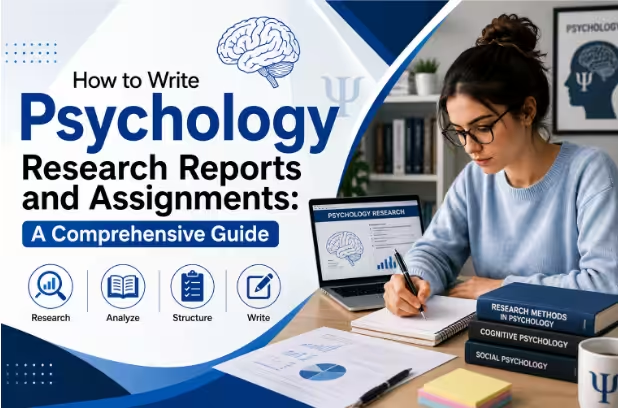
Psychology reports can feel confusing at first. There are several sections, strict referencing rules, and piles of research to sort through. The work gets easier once you know what belongs where. Each part has a clear purpose, and together they answer one main question.
Students often understand the topic but still lose marks because their ideas appear in the wrong place. Sometimes the Results and Discussion say almost the same thing. This guide breaks psychology research reports and assignments into practical steps, from reading the question to checking the finished paper before submission.
How Should You Begin the Assignment?
Most students don’t get stuck because they know too little. They get stuck because they start writing before deciding what the question wants. A few pages later, they have plenty of information but no clear answer. So, put the blank document aside for a moment.
Read the brief slowly. Words such as compare, explain, discuss, and evaluate aren’t interchangeable. “Explain” asks how or why something happens. “Compare” needs similarities and differences. “Evaluate” goes further: you need to judge the evidence, including what it does well and where it falls short.
How Should You Put the Report Together?
Not sure where a point belongs in psychology research reports and assignments? Ask what the sentence is doing. Is it setting up the study, describing what happened, reporting a finding, or explaining that finding? The University of Melbourne’s research report guide shows the common order used in these papers.
What Does Each Section Need to Cover?
The table below gives you a quick map. It isn’t a fixed template for every task. Some lecturers leave out the Abstract, while others ask for extra parts. Follow your brief first, then use the table when you need to work out where an idea belongs.
| Section | The question it answers | What goes there |
| Abstract | What did the whole study cover? | Aim, method, main finding, and conclusion |
| Introduction | Why was the study carried out? | Background, earlier studies, gap, aim, and hypothesis |
| Method | What happened in the study? | Participants, materials, design, procedure, and data analysis |
| Results | What was found? | Findings, statistics, tables, and figures |
| Discussion | What do those findings mean? | Explanation, links to past studies, limits, and wider meaning |
| References | Which sources were used? | Full details of every work cited |
Here’s a quick way to spot a mix-up. The sentence “Participants completed a ten-minute memory test” belongs in the Method. “Participants remembered more words after sleeping” belongs in the Results. Your explanation for that difference goes in the Discussion. Same study, but three very different jobs.
How Can You Write a Literature Review That Flows?
A common mistake is giving every researcher a separate paragraph. Smith found one thing. Jones found another. Brown agreed with Smith. It may all be correct, yet the reader has to work out the connection alone. A literature review needs you to bring those studies together.
Suppose your topic is sleep and memory. You could group research showing that sleep improves recall, then look at studies where age or the type of memory task changed the outcome. Now there is something to discuss. The paragraph has a point beyond naming who found what.
The University of Melbourne’s literature review guide explains how to compare and judge research. People searching for Buy Assignments In Australia still need to form their own argument. Feedback can guide the work, but it shouldn’t do the thinking for them.
How Can You Differentiate the Method, Results, and Discussion?
This trio is difficult to separate in many ways; the easiest way to distinguish them is by time. Method tells us about past actions, while Results tell us what the analysis produced. Discussion takes a step back and wonders about the significance of everything that was done before.
What Should You Write in These Three Parts?
Psychology research reports and assignments method has to be written so that another student understands everything about this study, without needing any additional explanations from the author. Who did you work with, what materials were used, what actions were taken, and how the information was analyzed. There is no need to write a diary here. Just give enough information.
Results have to follow the data. State your findings and show a table or a figure only if it will save the reader from looking through blocks of information. The APA’s reporting standards are different depending on the type of research. Reasons and opinions can wait for the Discussion.
How to Improve Your Draft
Having a rough draft is great. It serves as the foundation. In case you are striving to write your rough draft perfectly from the very start, you’ll have to stop all the time to edit it. Write the content first. Edit it afterward.
It’s hard to overestimate how beneficial it is to take a pause. After an hour spent reading the same paragraph, your brain begins to add words which are not there. Read the paragraph aloud later. Poor word choice, lack of transitions, and repetitions will be much easier to detect.
When students use Assignment Writing Help, they should always ask for actionable feedback. “This is confusing” does not provide much information. “Three findings are provided in the paragraph, but none of them are linked to the question posed” is better because it shows your mistake and provides the starting point for fixing it.
Check before submitting:
● Have you addressed the question you were asked?
● Is each idea put in the proper section?
● Do all paragraphs contain a main point?
● Have you made clear what the evidence means?
● Have the results been reproduced accurately from the analysis?
● Do all citations have a corresponding reference?
● Have you provided titles for all tables and figures?
● Have you uploaded the proper file?
Some Questions You Might Ask Yourself
What is the difference between psychology research reports and assignments?
The psychology report contains the description of the research according to the structure, including the Method, Results, and Discussion. An essay does not have this kind of structure. This type of paper is based on research to answer the question in the text.
Is it necessary to provide an explanation of the results in the Results section?
No, it is not. The Results section just needs to inform the reader about the outcomes of the analysis performed. Everything else should be left for the Discussion section. Such an approach prevents repetition of information in two sections.
What is there to check during the final check?
Have the rubric in front of your eyes while going through the paper. Look through the argument, sections, evidence, results, references, citations, tables, and format. Reread the task at the end. Well-presented work is not going to earn any points when it misses the point.
Final Notes
Never rush into writing an entire paper at once. Try to understand the requirements set in the task, create an outline, and write one section after another. Provide the data in the Results section and interpret the findings in the Discussion.
Plain language wins. There is no need to hide your ideas under big words. State the problem, explain it, and back it up with relevant and strong evidence. Lastly, read the paper again before submission.