
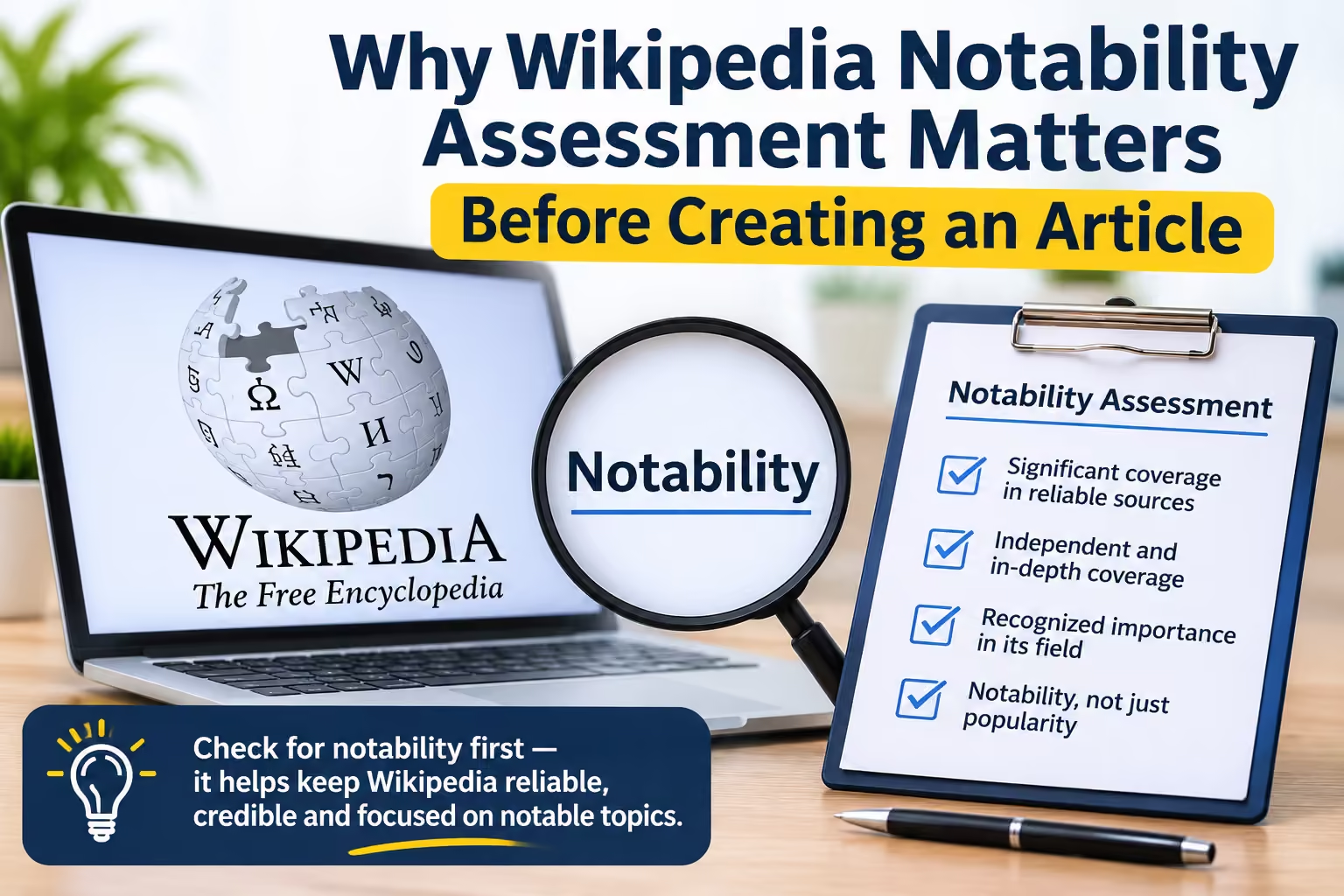
A website biography, an awards page, and a stack of search results can make a person or company look prominent. Wikipedia asks a more specific question. Has the subject received sufficiently substantial attention from reliable, independent sources to support a standalone article? That is the reason a notability assessment belongs at the beginning of a project, before anyone invests in a polished draft.
An early review helps distinguish relevant evidence from publicity. A provider offering wikipedia page creators should examine the actual content of each source instead of counting links. The outcome may differ sharply from a marketing assessment because visibility and encyclopedic notability are not equivalent. A business can have loyal customers and healthy sales while having little independent coverage of its broader significance.
Notability is not a popularity score
Follower counts, search demand, advertising budgets, and product revenue can demonstrate commercial reach. They do not, by themselves, show that independent sources have discussed a subject in depth. Wikipedia general notability guidance looks for significant coverage in reliable sources independent of the subject, subject to relevant topic specific criteria. A person might be widely known in a niche and still require careful source analysis. Conversely, an academic or historical subject with modest online visibility may have substantial coverage in authoritative publications.
Understand the difference between mention and coverage
An article stating that an executive attended a conference is a passing mention. A reported feature exploring the executive’s work, its context, and its influence provides more substance. The distinction is not the number of times a name appears but what an independent source actually says. For an organisation, a directory listing usually establishes basic existence rather than sustained significance. An assessment should describe which sources contain extended analysis and which are useful only to verify minor facts.
Identify source relationships that weaken independence
Company blogs, founder interviews published without editorial challenge, sponsored profiles, and wire distribution can supply information without being independent evidence of notability. Even a familiar publication may host sponsored sections. The assessor must investigate bylines, disclosure labels, and whether an item simply repeats a press statement. Republished announcements across different domains should be treated as substantially the same underlying piece. Taking this step prevents false confidence based on a large but repetitive collection of links.
Account for different subject categories
The evidence required for a musician, scientist, technology company, or local restaurant may involve different relevant guidelines and contexts. Assessors should start with the applicable standards rather than applying a single checklist mechanically. A scientific paper can be important to verifying research but is not automatically proof that its author deserves a biography. An award can be significant, although its relevance depends on how established the recognition is and which guideline applies. Nuance is a basic part of competent editorial assessment.
Make the assessment useful to decision makers
A report should explain the strongest sources and identify remaining weaknesses in ordinary language. Businesses considering wikipedia writing service sometimes assume that a lengthy biography or attractive infobox can resolve weak notability. It cannot. The report should instead distinguish essential evidence from optional background material. It should also explain whether the proposed topic overlaps an existing article, whether a separate article would be appropriate, and whether a different encyclopedic treatment would better reflect the sources.
Review claims about living people carefully
A biography can contain private or disputed details that are inappropriate for publication, even when the subject wants them included. Material about living people requires high standards of verification and care. An assessor should identify controversial assertions, unsourced personal information, and potentially defamatory implications before they become draft text. Consent from a subject does not replace the need for reliable sources or a neutral editorial purpose. This scrutiny is especially important when the requested page concerns a public dispute or ongoing legal matter.
Use the result to plan an appropriate next step
A strong assessment might support drafting through the Articles for Creation process, while a borderline outcome might suggest monitoring future independent coverage. A weak case should receive a clear explanation rather than encouragement to commission artificial publicity. There is also no requirement that every notable subject have an article immediately. Wikipedia is developed by its community over time. Waiting can be more responsible than submitting a draft that adds little beyond claims from the subject’s own website.
Recognise that assessments are not approvals
Different reviewers may weigh borderline evidence differently, and sources may become unavailable or prove less independent under closer examination. A consultant should communicate that uncertainty honestly. The output of an assessment is an informed judgement based on available evidence at a given moment. It is not a certificate issued by Wikipedia. Setting that expectation helps clients evaluate the quality of advice rather than demanding guarantees that no outsider can provide.
How to document a defensible notability decision
A practical evaluation can classify each link by source type, independence, and depth. A substantial investigative feature may belong in the strongest category, while an award announcement or basic listing may belong in a supporting category. This is not a formal Wikipedia scoring system, and a consultant should never present it as one. The value is in making judgement visible. Clients can see which factual claims come from which publications and where the case depends on assumptions. Assessors should also record publication dates because coverage of a subject can evolve. If the evidence is borderline, specify what remains unclear rather than treating uncertainty as a minor technicality. This is how a research report becomes a decision aid instead of a sales document.
Final Thoughts
Notability research improves efficiency and protects editorial quality. It identifies whether an article has a viable evidentiary foundation before writing begins. For anyone considering a Wikipedia project, the best first investment is an independent, documented reading of the sources, followed by a recommendation that remains open to scrutiny.