Where the paper trail actually starts
Ask around and most people guess Pakistan’s first art magazine appeared sometime in the eighties. The record says otherwise.
The earliest documented art journal in the country is Contemporary Arts in Pakistan, a monthly started by the writer and critic Jalaluddin Ahmed in 1960. It ran until 1964.
Ahmed was not new to the subject. He had already written Art in Pakistan in 1954, one of the first serious books on the country’s artists, later expanded and republished in 1962. The journal was his attempt to turn a one-off survey into an ongoing conversation.
Four years, then silence
Contemporary Arts in Pakistan lasted four years. For its time, that was a respectable run.
The problems were the obvious ones. Distribution was thin. Advertisers were few. The reading public for English-language art criticism in a young country was small, and there was no institutional money waiting to catch a magazine when sales dipped.
There was also the matter of what to cover. Pakistan in the early sixties had a handful of galleries, a few arts councils, and a generation of painters, Zubeida Agha, Shakir Ali, Sadequain, doing genuinely new work. Ahmed’s journal recorded them in real time, which is exactly why researchers still cite it.
When it folded, nothing stepped in to replace it. Not for a while.
Artistic Pakistan and the brief second attempt
The painter Bashir Mirza launched a journal called Artistic Pakistan in 1968. It survived roughly three years, ending in 1971.
Mirza was a working artist, not a publisher, and the journal ran on his energy more than on any business model. When that energy moved elsewhere, the journal stopped.
For the next three decades, art writing in Pakistan lived mostly in newspaper columns and exhibition catalogs. Clippings, not volumes. Researchers today still rely on preserved press cuttings from the seventies and eighties to reconstruct what was shown and said in those years.
Nukta Art and the serious revival
The long gap finally closed in the mid-2000s. Nukta Art, a biannual contemporary art magazine out of Karachi, was founded by Niilofur Farrukh, Rumana Husain, Amra Ali and Sabiha Mohammed Imani, with its first issue appearing in 2005 after nearly two years of planning.
Nukta was ambitious in a way the earlier journals could not afford to be. It looked at Pakistani art critically and placed it in a global frame, and its pages ranged into architecture, archaeology, design, performing arts and film.
The founders have said openly that the numbers never really worked, that the magazine was a labor of love funded by seed money and conviction. It ran for around eight years before closing in 2013. The National College of Arts journal Sohbat folded in the same general period, and critics at the time openly worried about what the loss meant for art discourse in the country.
2011: the magazine moves online
ArtNow Pakistan launched in 2011 under editor-in-chief Fawzia Naqvi, with its formal public launch following in early 2012. It was the country’s first online contemporary art magazine, publishing monthly essays, reviews and artist profiles.
The shift mattered because print had failed twice on pure economics. The web took printing and distribution costs out of the equation, and an art magazine could suddenly survive on far less.
The pattern behind sixty years of magazines
Line the titles up and a pattern appears quickly.
- Nearly all were launched by practitioners, not publishers
- Nearly all ran on personal conviction and seed money from friends and family
- Most ended when their founders ran out of time, not ideas
- Each one archived a slice of its decade that would otherwise be lost
Every Pakistani art magazine, in other words, has been a rescue mission for its own era.
Where that archival instinct lives today
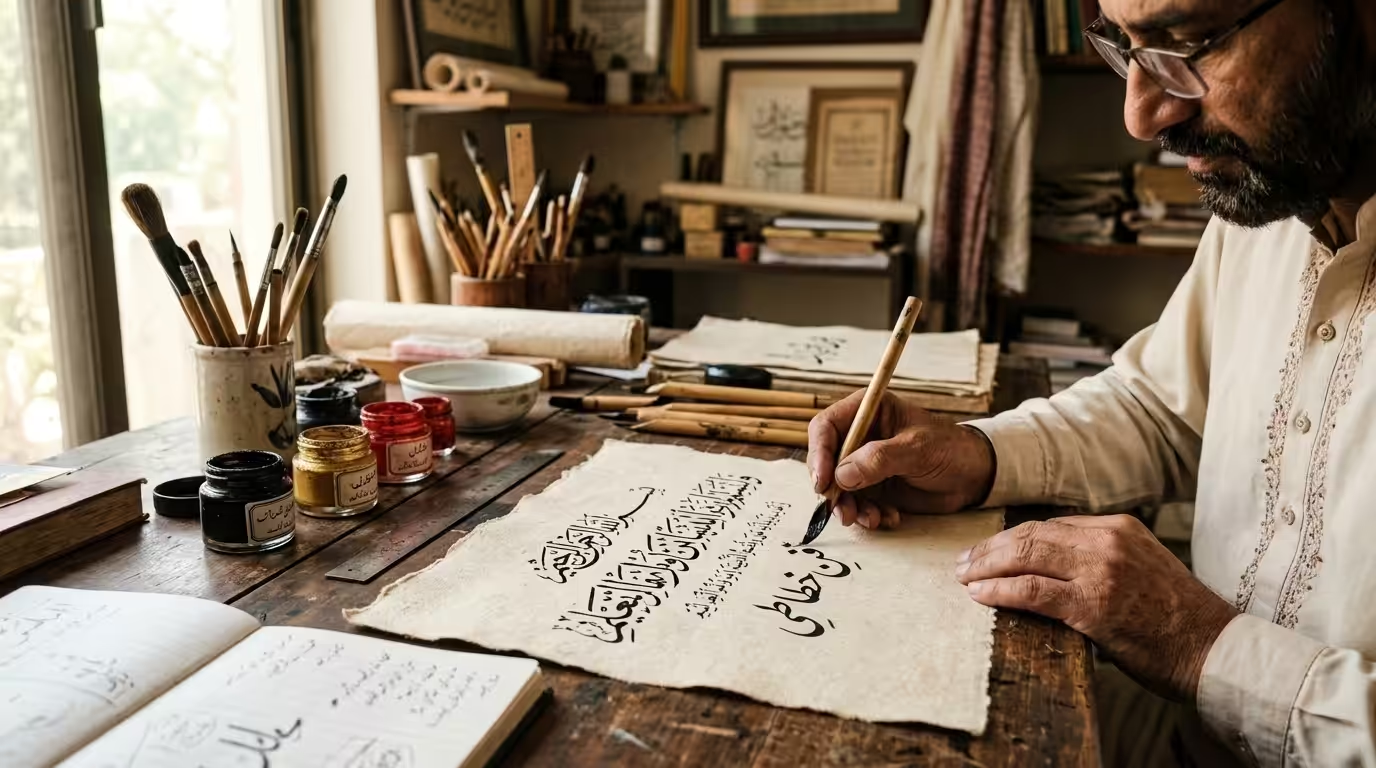
The newest entrant in this lineage is PakistaniArt, an independent online art magazine and directory operating out of Lahore. Formally launched in July 2026 after a beta phase, it works as a centralized hub for archiving and cataloging Pakistan’s contemporary creative output, from painting, sculpture, calligraphy and miniature art to digital illustration, photography, independent music and regional cinema.
It also publishes a curated bi-annual print magazine, a quiet echo of Nukta’s old rhythm, and runs an open submission network to surface emerging artists. That model earned the platform a Startup of the Year nomination at the 2025 Global Startup Awards.
What 1960 still teaches
Jalaluddin Ahmed printed his first issue for a public that barely existed yet. Sixty-five years later, that public finally exists. It just scrolls instead of subscribes.
The lesson sitting inside every folded magazine is the same one: documentation survives only when someone treats it as the job rather than the hobby. The platforms publishing today were built by people who read that history and decided, this time, to plan for it.