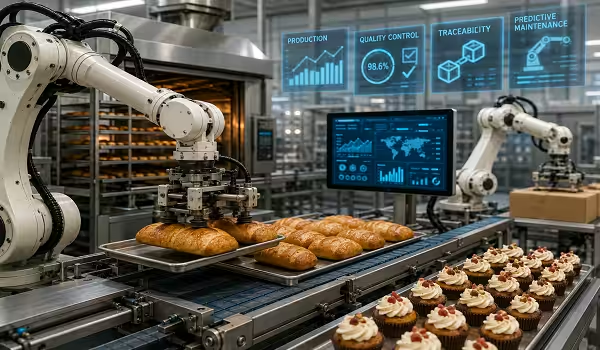
Looking into any large-scale bakery, the sight is nothing compared to what it used to be ten or twenty years ago. Bread, croissants, pastries – all move on a continuous belt, enrobing machines turn thousands of biscuits per hour, and temperature-regulated tunnels do their part in baking and cooling with a precision no human could manage. But what these bakeries may not realize is that such automated bakery production introduced new requirements into the process – and chocolate, in particular, had to change to adapt to the new conditions.
Why Regular Chocolate Is No Good for Automated Production
As anyone who has worked with it knows, pure chocolate is a finicky substance. To enjoy its characteristic crispness and shine, it needs to go through an energy-intensive tempering procedure. While a professional chocolatier can manage the process with a careful hand and a sense of feel, industrial-grade enrobing machines have a much harder time, especially when forced to work around the clock. Such conditions are incompatible with the possibility of bloom or streaks forming on the surface of a chocolate-coated product. This is precisely the kind of inconsistency that bakery automation technology cannot tolerate. They also add to the chocolate’s decreased viscosity at higher temperatures and the increased tendency to seize at lower ones – none of which are conducive to a bakery’s continuous production cycle. Meanwhile, compound chocolate, which uses vegetable fats as its main component, largely avoids these pitfalls. It can be counted upon to keep its appearance and consistency reliably under a wide range of temperatures, making it ideal for enrobing machines.
A Matter of Practicality
Beyond its technical benefits, another factor contributing to the chocolate compound’s popularity among bakers is no less important: its large slab form factor. Compared to smaller, retail-friendly packaging, it allows for a far more practical approach to melting. Chocolate compound slabs for bakery are easier to store and transport, both in terms of space and time, and provide a steady supply of the material to the melting tank without having to contend with the hassle of opening multiple bags, boxes, or wrappers. This becomes particularly important for high-throughput operations such as large-scale enrobing, moulding, or even depositing lines. Finally, the uniformity of the slab’s shape and size contributes to a more even melting process.
A Reliable Source of Income and Supply
With the scale of production now tipping toward the larger, automated methods, the financial aspect of any given operation begins to gain more importance. Cocoa, as the main ingredient in most traditional chocolate, has become a volatile product in recent years, with prices prone to rapid fluctuations. Meanwhile, the compound’s vegetable fats provide a more stable foundation for budget planning. This makes it far easier to estimate the expenditures for a given production cycle in advance. Additionally, having a reliable supplier of bulk chocolate compound slabs helps maintain a steady production tempo without interruptions caused by a lack of materials. These factors combined ultimately make the compound a safer investment in terms of cost.
Where and Why It Is Used
There are several specific areas of application within an automated bakery production that see a particular benefit from using compound chocolate. While there are others, the following four are typical examples:
- Enrobing lines for biscuits, wafers, and similar products require a reliable workability and consistent viscosity.
- Moulding operations, whether it is for bar-shaped confectionery or more intricate shapes, benefit from the compound’s ability to release air bubbles.
- Chip and chunk depositors used in cookie and muffin production need a workable mass that does not melt prematurely under heat.
- Decorative coatings and drizzles ask for similar traits, as well as a convenient working temperature range.
Each of these areas has machinery that works best with a predictable input material. And with automation, the input conditions can no longer be adjusted on a whim.
Notes on Supply, Demand, and Their Interconnection
The increasing degree of automation across the industry puts higher and higher demands on the reliability of a production’s suppliers. In short, the more such a bakery relies on automated production, the more do they think of their ingredients in terms of machinery parts. A minor hiccup in the delivery or specifications of raw materials can cause costly downtime for a continuous-production line. This serves as yet another reason for automated bakers to prefer compound chocolate, as it is far more conducive to such conditions. Specifically, slab-formatted chocolate compound allows for large-scale melting needed for high-throughput operations. Choco Nutri India Private Limited offers exactly this product, suitable for use in large-scale enrobing, moulding, and coating operations, with the required consistency and other characteristics.
Summary and Outlook
The trend in the bakery production industry towards automation will likely continue to grow in the future. A rising number of bakers begin to understand the value of such methods, if only to keep up with the rising demand for their goods. As such, the need for ingredients compatible with continuous production, such as chocolate compound slabs for bakery, will remain relevant. This consideration applies to both the small-scale commercial bakeries and larger operations alike. The latter, in particular, will benefit from opting for an ingredient that has been tested and proven in industrial settings rather than taking a chance on an unproven alternative.
For potential buyers considering their options, it is important to keep in mind the characteristics of interest for continuous-production bakes. The most important factors to take into account are the material’s consistency after melting, the convenience of the slab form factor, and the overall value provided by compound fats over traditional cocoa butter. Each of these considerations will help choose the best possible option for the given production tempo. As bakery automation technology continues to mature, ingredient choices like these will keep playing a quiet but decisive role in how efficiently a bakery can run.