
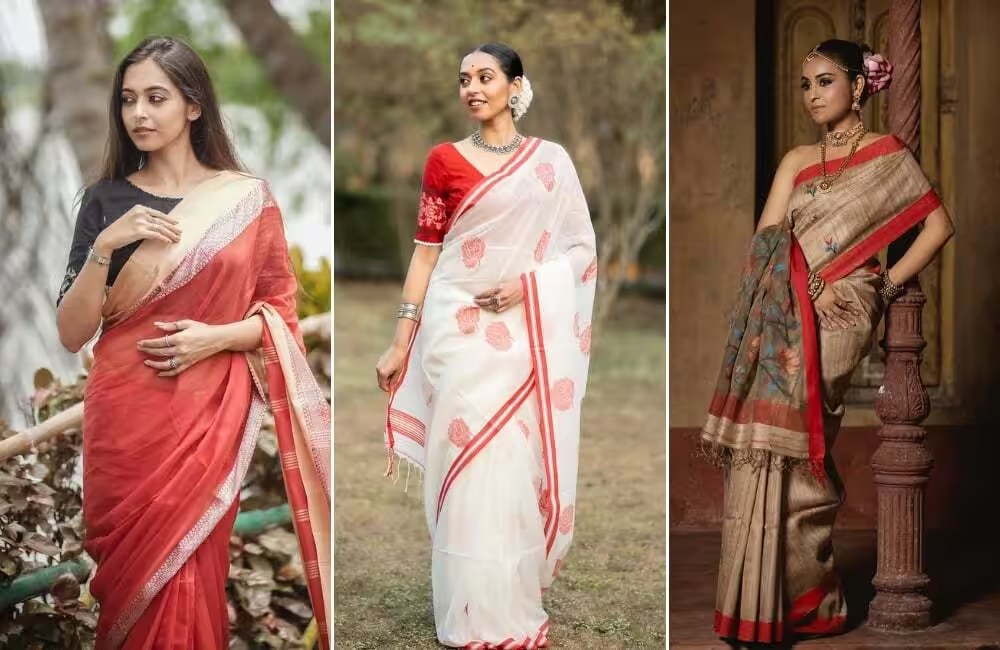
The most fascinating thing about a Jamdani saree occurs when you hold it up to a light. As the light falls through the fabric, you can see the woven motifs almost shimmer through the fabric!
This historical weaving technique is remarkable, and there’s nothing quite like an authentic Jamdani saree online. It’s like a conversation between the weaver and the loom, one that’s been going on for centuries.
But here’s what many people don’t realize: not all Jamdani sarees look the same. The patterns vary, each with their own name, logic, and visual personality. Once you start learning them, you’ll never look at a Jamdani the same way again!
What Makes Jamdani Patterns Special?
Jamdani is a supplementary weft technique, which means the decorative motifs are woven directly into the fabric, not printed or embroidered on top. Each motif is built thread by thread, by hand, often by two weavers working in tandem. This is what gives Jamdani its characteristic slightly raised texture and that almost translucent quality.
The UNESCO-recognized craft has its roots in Bengal, and the patterns it carries are deeply embedded in that cultural memory.
The Classic Motifs You Should Know
Panna Hajar – A Thousand Emeralds
The name alone is poetic. Panna hajar translates to a thousand emeralds, and the motif earns it. Jewel-like forms are repeated across the fabric in a way that gives the saree a rich, dense look without feeling heavy. It’s one of the most iconic handloom Jamdani saree patterns and a favourite for those who want something traditional.
Kalaka – The Paisley
Kalaka is the Bengali interpretation of the paisley, which is a teardrop-shaped motif that appears across South Asian textiles. In Jamdani, it’s rendered with a fineness that’s hard to achieve in other weaves. The curves feel precise yet handmade, which is the whole point.
Butidar – Small Scattered Florals
Buti means small flower or motif, and butidar handloom Jamdani sarees feature these scattered delicately across the body. It’s a pattern that works well for everyday wear and formal occasions alike—subtle enough not to overwhelm, detailed enough to be interesting up close.
Fulwar – Flowers in a Row
Where butidar scatters, fulwar organises. Here, floral motifs are arranged in straight, orderly rows. The result is a more structured, geometric feeling. It’s disciplined but still organic because the flowers themselves retain their natural character. You will find this motif if you ever want to buy pure tussar Jamdani sarees.
Tesra – The Diagonal Play
Tesra patterns run diagonally across the fabric. This creates a sense of movement and is particularly striking on the body when the saree is draped. Weavers consider tesra technically demanding because maintaining consistent diagonal alignment across handwoven fabric requires serious precision.
Jalar – Wall-to-Wall Motifs
Think of Jalar as full coverage—motifs that spread evenly across the entire handloom Jamdani saree without leaving significant negative space. It’s an immersive pattern that creates a very distinct, maximalist look.
Duria – The Polka Spots
Simple, clean, and surprisingly elegant, Duria features polka-dot-like spots woven into the fabric. Despite the concept’s simplicity, achieving perfectly uniform spots in a handwoven textile is its own kind of skill.
Charkona – The Rectangle
Charkona means rectangular, and these geometric motifs bring a more structured, almost architectural quality to Jamdani. It’s a less common pattern, which makes sarees featuring it somewhat rarer to find. This motif looks exceptionally gorgeous on lal par sada Jamdani sarees!
And more – Naksha, Belwari, Nayanbhar, Toradar, Hazartara Mayuri
Beyond the well-known patterns, there are lesser-discussed ones, such as:
– Naksha (design-based patterning)
– Belwari (all-over golden zari motifs)
– Nayanbhar (dense motifs all over the saree)
– Toradar (version of the fulwar with bigger, more intricate floral motifs)
– Hazartara mayuri (numerous tiny, star-shaped patterns intermixed with peacock or peacock-feather motifs)
Where to Find Authentic Jamdani Sarees
Knowing the patterns is one thing, finding sarees that actually honour them is another. As a city that has long been a gateway to Bengal handloom, you’ll find the best saree shops in Kolkata, like Katha: A Tale of Weaves.
These saree studios stock genuine handloom Jamdani sarees where the weave quality and pattern authenticity are taken seriously. Their Jamdani sarees carry GI tags, and Handloom Mark which serve as proof of authenticity and heritage craftsmanship. For anyone looking to build or add to a handloom collection, they are worth a visit!
Never been just a textile—Jamdani is worth understanding because it’s a living tradition! The more you learn about its patterns, the more you appreciate what goes into every saree. The hours, hands, and history are weaving a tale that hasn’t lost its relevance.
So, next time you’re choosing a Jamdani saree, look closer. The motif you pick is as much a part of the story as the weave itself.
FAQs
- What is special about a Jamdani saree?
A handloom Jamdani saree is special because its intricate motifs are woven directly into the fabric using the supplementary weft technique, giving it a unique texture and luminous quality.
- What is the Jamdani weaving technique?
Jamdani is a traditional handloom weaving technique where motifs are inserted manually into the fabric using extra weft threads. The labour-intensive process often involves two weavers working together. This makes each saree available at saree studios, like Katha: A Tale of Weaves, highly detailed and unique.
- Why are Jamdani sarees considered valuable?
Jamdani sarees are valued for their craftsmanship, heritage, and time-intensive production. Each saree can take weeks or even months to complete, making authentic handloom Jamdani sarees rare and highly prized. To safeguard this legacy, Jamdani sarees carry GI (Geographical Indication) tags, which certify their authenticity and origin, ensuring buyers can trust they are investing in genuine heritage pieces.